DeepCrossAttention Reinvents Residual Connections to Speed Up Transformer Training
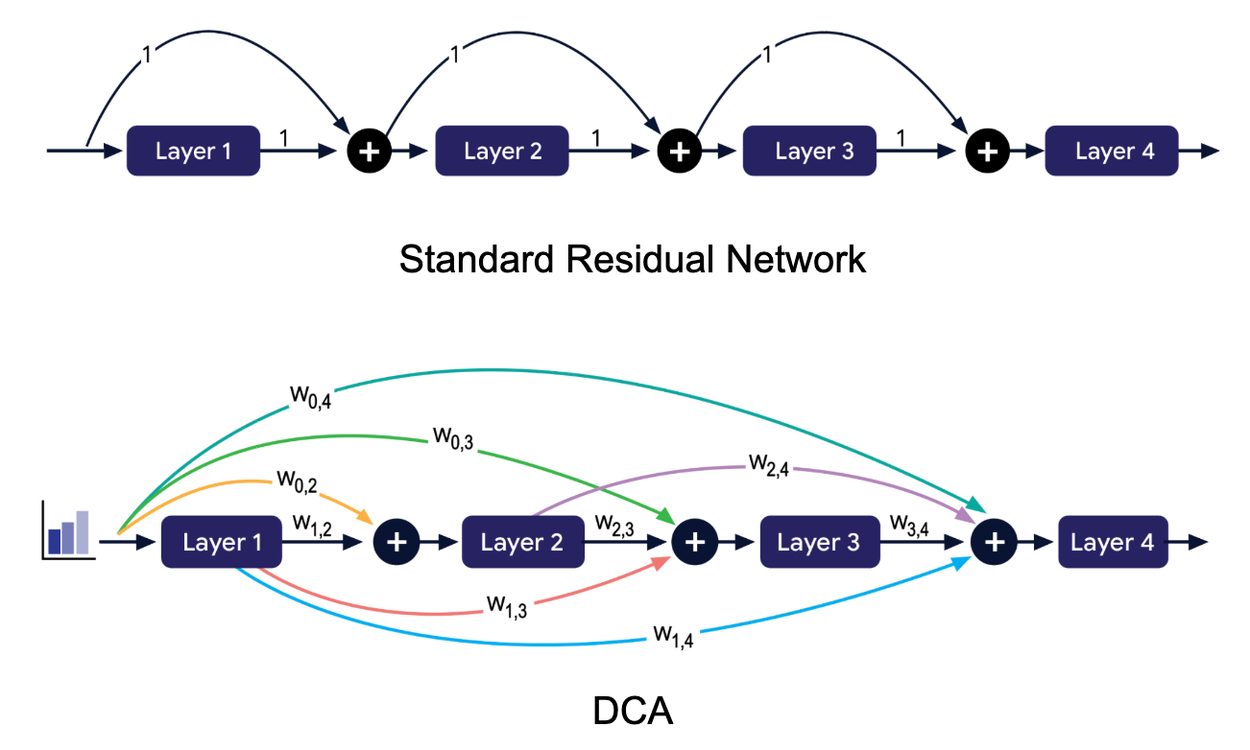
Deep neural network architectures have long relied on standard residual connections to pass original inputs forward, but the practice often causes critical information to become diluted across deep layers. To address this limitation, researchers have introduced DeepCrossAttention (DCA), an architecture showcased for the ICML 2025 conference that replaces rigid additive connections with learnable weights and depth-wise cross-attention. By enabling layers to dynamically select and route features from earlier stages, DCA prevents the uniform degradation of representations while accelerating training speeds by up to three times.
Dynamic Routing and Structural Efficiency
Standard skip connections treat every preceding representation equally, often averaging out or distorting specific signals as network depth grows. In contrast, DCA computes token-specific mixing weights by combining a learnable base with an input-dependent projection. This allows dynamic layer routing, where the network adapts its processing pathways for each individual token.
To manage these interactions efficiently, the design relies on depth-wise cross-attention using split queries, keys, and values across network depth. Each token queries a dynamically weighted synthesis of prior layer embeddings rather than receiving a fixed identity sum. This structural flexibility allows networks to trim parameter counts by 30 to 40 percent while achieving equivalent or superior learning outcomes.
Performance Benchmarks and Retrofitting
Empirical evaluations across the C4 and LM1B benchmark datasets indicate substantial computational gains. DCA reached the baseline performance of standard transformers in up to five times fewer training steps and maintained lower perplexity across identical training budgets. In one benchmark on LM1B, a 30-layer DCA architecture surpassed the perplexity score of a conventional 42-layer transformer, achieving a 29 percent reduction in both parameter count and network depth.
Remarkably, the mechanism introduces an overhead of less than 0.2 percent of the overall model parameter budget, ensuring that compute and memory footprints remain largely unaffected despite higher memory bandwidth utilization. The framework also demonstrates utility beyond training from scratch: retrofitting DCA onto an existing pre-trained transformer and conducting brief follow-up training yielded a perplexity drop of 0.19 on LM1B, contrasting sharply with a modest 0.02 reduction achieved through standard continuation training.